We’ll Meet Again
Pamela's War“We’ll Meet Again” is both a song and a recurring emotional promise in Pamela Wheeler Fellows’s account of the Second World War. Its words offer the possibility that lovers and friends separated by military service will one day be reunited, but the narrative turns that promise into an elegy: for Pamela, David’s death makes the song’s reassurance painfully false, while the disappearance of a whole circle of young men reveals the scale of wartime loss behind its comforting refrain.
The Promise of Reunion
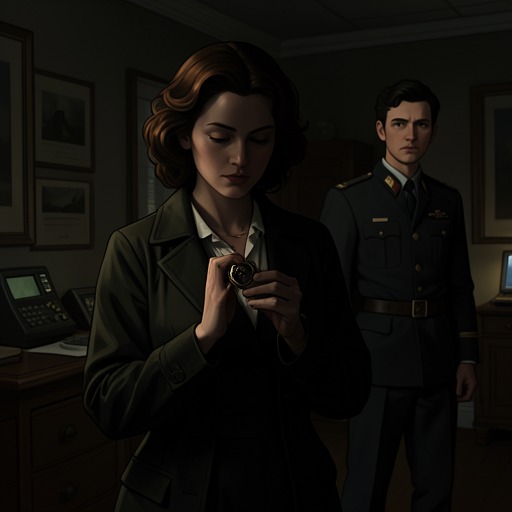
The song enters the narrative after Pamela has fallen in love with David, a twenty-four-year-old visitor to The Woodman Hotel who begins appearing in his Royal Air Force uniform. Pamela is seventeen, and her father’s restrictions are severe: she is forbidden to leave the hotel or walk onto the car park with any of the young men who visit, and she must never be alone with one of them. Because Sidney Wheeler will not approve of an RAF admirer, Pamela and David arrange for her to say that she is attending a dance with Gloria instead. The song’s promise therefore belongs from the beginning to a world of concealment, parental authority, military danger, and interrupted courtship.
Their relationship briefly creates an intensely private alternative to the war surrounding them. After Pamela serves a meal to David and his friends in the upstairs dining room, the tables are pushed aside and David sweeps her into a dance. At the end of the evening, despite her father’s surveillance, she reaches the car park to say goodnight. The late-summer scene, David’s friends waiting in the car, and the single kiss give the future a shape in Pamela’s mind: she believes that David is the man she will marry. The couple promise to take care of themselves and keep safe, a practical wartime version of the song’s emotional assurance. Yet the narrative immediately places that promise under threat by stressing that wartime circumstances can be cruel.
From Courtship to Foreboding
Pamela does not know that she will never see David again. Days pass while she thinks of him constantly, and the separation initially remains suspended between hope and anxiety. The song’s imagined future depends on uncertainty: the lovers do not know where or when reunion will occur, but they retain the conviction that it will occur somewhere, sometime. In Pamela’s experience, however, uncertainty becomes a form of mourning before official confirmation arrives.
On September 5, 1941, Pamela travels with Gloria to Dudley for the wedding of friends. During the service, on what should be a happy autumn day, she is overcome by an unprecedented feeling of doom so powerful that it makes her physically ill. She tells Gloria that she is certain David has just died, even though she has no visible information that could establish this. Her certainty is presented not as a reasoned deduction but as an overwhelming knowledge that she cannot explain. The song’s confidence in eventual reunion is thus shadowed by a more terrible conviction: the absent beloved may already have crossed from separation into death.
The Song as Consolation and Contradiction
David’s death is confirmed, and Pamela is left numb with shock and grief. Sidney Wheeler decides that it is too risky for her to travel to Scotland, where David’s funeral is to take place; after one tragedy, he considers further danger intolerable. Pamela’s final gift must therefore be delivered by proxy. She sends a wreath of twelve red roses to Scotland, where it is placed on David’s coffin, and writes a poem on the reverse of his photograph, preserving his laughing smile and carefree manner in a personal memorial. She feels that her heart will break, but the photograph and the roses give her grief material forms when physical farewell is impossible.
At this point, the words of “We’ll Meet Again” provide temporary comfort. Pamela recalls its assurance: “We’ll meet again,” followed by the uncertainty of not knowing where or when, and the hope that reunion will come on “some sunny day.” The quotation is not presented as a neutral cultural reference. It functions as an emotional instrument with which Pamela tries to endure the unbearable gap between love and death. Its simplicity makes it available to everyone, but that very simplicity also exposes the difference between a public promise of morale and the private facts of wartime bereavement.
A Generation That Does Not Return
The promise fails not only in Pamela’s romance but across the social world of the hotel. Shortly after David’s death, Max, the pilot whose low-flying Stirling bomber had once thrilled Pamela and angered her father, is killed in his aircraft during a raid over Germany. The original group of twenty young men who come to the hotel for drinks diminishes week by week. They disappear one by one, reported only as missing or dead, while the family and friends left behind receive the briefest details and are discouraged from discussing the circumstances. Official silence, supposedly connected with secrecy or morale, intensifies rather than relieves the horror.
The song’s repeated promise becomes an index of absence. The young men are not merely separated from their companions; they have gone forever, and the narrative explicitly concludes that “We never do meet again.” The contradiction between the song and the outcome is the central significance of its appearance. Its hopeful language survives as a cultural refrain, but the lives it promises to restore cannot be restored. What began as a lover’s expectation becomes an elegy for a generation whose futures, marriages, work, and ordinary companionships are erased by military loss.
Private Grief and Public Wartime Spirit
The song belongs to a wider wartime culture in which music, broadcasting, humour, and communal ritual help people endure fear and deprivation. Radio programmes, Churchill’s speeches, Charles Hill’s health advice, and comedy broadcasts provide relief from bombing, shortages, and uncertainty. Wartime spirit brings strangers into conversation and makes people offer lifts and practical help to those they have never met. In that setting, “We’ll Meet Again” can operate as a collective promise, binding personal longing to national morale.
Yet Pamela’s story preserves the promise’s cost rather than allowing morale to erase bereavement. The same war that creates solidarity also destroys lovers, companions, and family futures. Later milestones—her marriage to John Fellows, her work making aeroplane parts in a hostile male factory unit, and the birth of her daughter on April 10—show life continuing amid scarcity and danger, but they do not undo David’s death or the loss of his companions. Even the celebrations on VE-Day, with street parties, bunting, Union Jacks, fireworks, bonfires, sandwiches, trifles, jelly, and cake released from hoarded supplies, coexist with families waiting for news of missing men. “We’ll Meet Again” therefore remains suspended between hope and testimony: a song of anticipated return that the memoir remembers chiefly through the people who never returned.